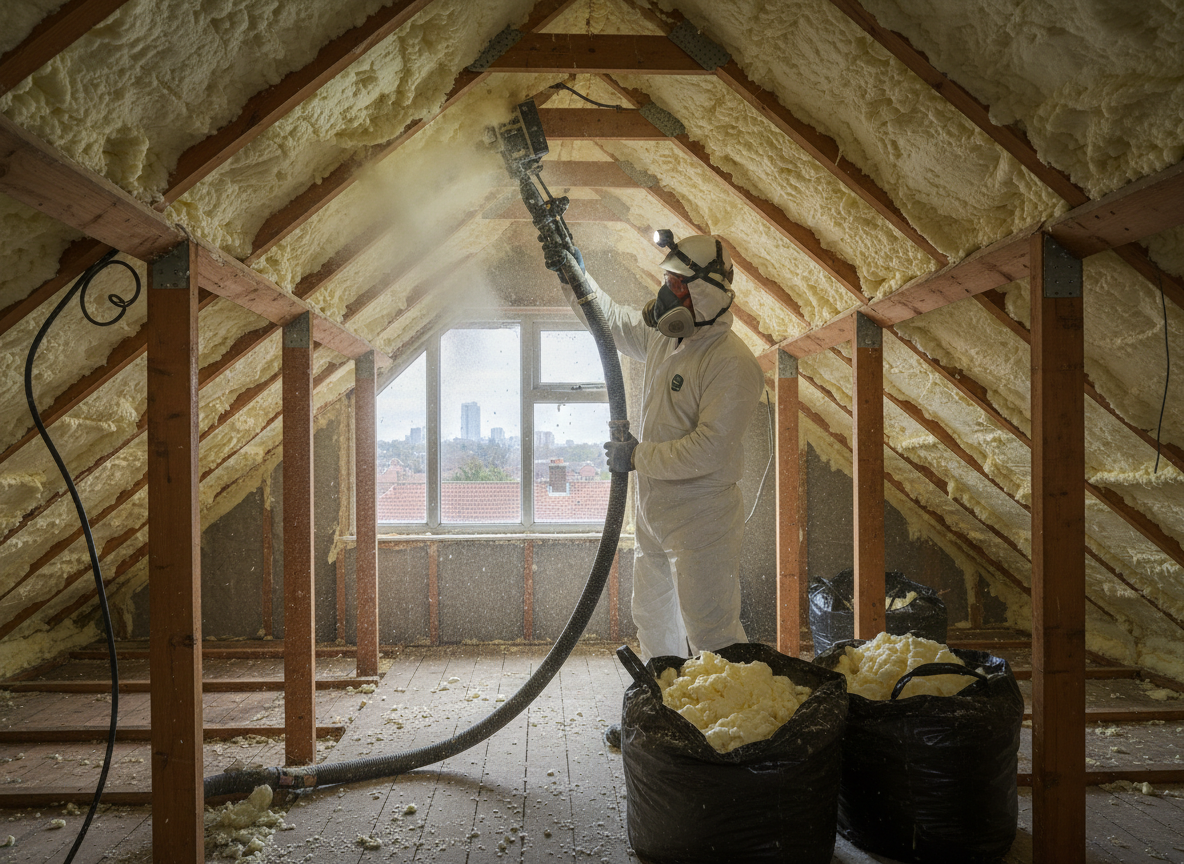
Open cell spray foam bonds tightly to timber joists and plasterboard in Croydon’s Victorian and Edwardian terraces, often found in areas like Thornton Heath and Shirley. Removal requires careful scoring and mechanical separation to avoid tearing original lath and plaster ceilings common in homes built before 1910. Moisture trapped behind the foam in these solid-wall properties can lead to rot if the foam is not fully extracted down to the substrate.
In post-war estates around New Addington and Addington Hills, open cell foam was frequently applied over mineral wool in the 2000s, creating layered insulation that must be removed in stages. Workers must ventilate lofts thoroughly because the material off-gases during cutting, and Croydon’s frequent damp winters make drying times longer than in drier regions. Edge cases include foam that has wicked into eaves and around chimney stacks where access is limited.
Local building control in Croydon requires that any re-insulation after removal meets current Part L standards, so crews document the exposed roof structure before leaving site. Homeowners in flats near East Croydon station often face party-wall complications where foam crosses boundaries, requiring coordination with neighbours to prevent disputes.
Equipment includes oscillating multi-tools fitted with vacuum attachments to capture debris, reducing mess in occupied homes. Full removal typically reveals original rafter spacing and any previous insulation remnants that must be cleared before new materials are considered.
Technician insight
In Croydon, the thing that catches most people out with open cell spray foam removal is how the material has seeped behind original lathe and plaster in pre-1910 terraces around South Croydon and Waddon. Once winter temperatures drop and the foam contracts, it pulls away from the joists in sheets that can drop dust into rooms below if you don’t contain the ceiling first.
Foam Removal in a Thornton Heath Terrace
Homeowners in a 1905 terrace near Thornton Heath station noticed musty smells in the loft after a wet winter. Inspection showed open cell foam had bridged behind the ceiling into the eaves. Crews set up containment, removed the foam in sections over two days, and revealed damp rafters that required drying before any new insulation could be installed.
How it works
- 1
Site Inspection and Access Assessment
Technicians examine loft access points, roof structure and any previous insulation layers in Croydon properties to plan safe extraction routes.
- 2
Containment and Ventilation Setup
Dust barriers and extraction fans are positioned to protect living areas, especially important in terraced homes where dust can travel between properties.
- 3
Mechanical Removal of Open Cell Foam
Foam is scored and peeled from rafters and ceilings using specialist tools, with debris collected immediately to limit airborne particles.
- 4
Substrate Cleaning and Final Check
Remaining residue is removed, timber is inspected for moisture damage, and the space is cleared for any follow-on work.
Pricing
Upfront quotes provided after on-site inspection at Interchange, Station Rd address; final cost depends on access difficulty and depth of foam in older Croydon housing stock.