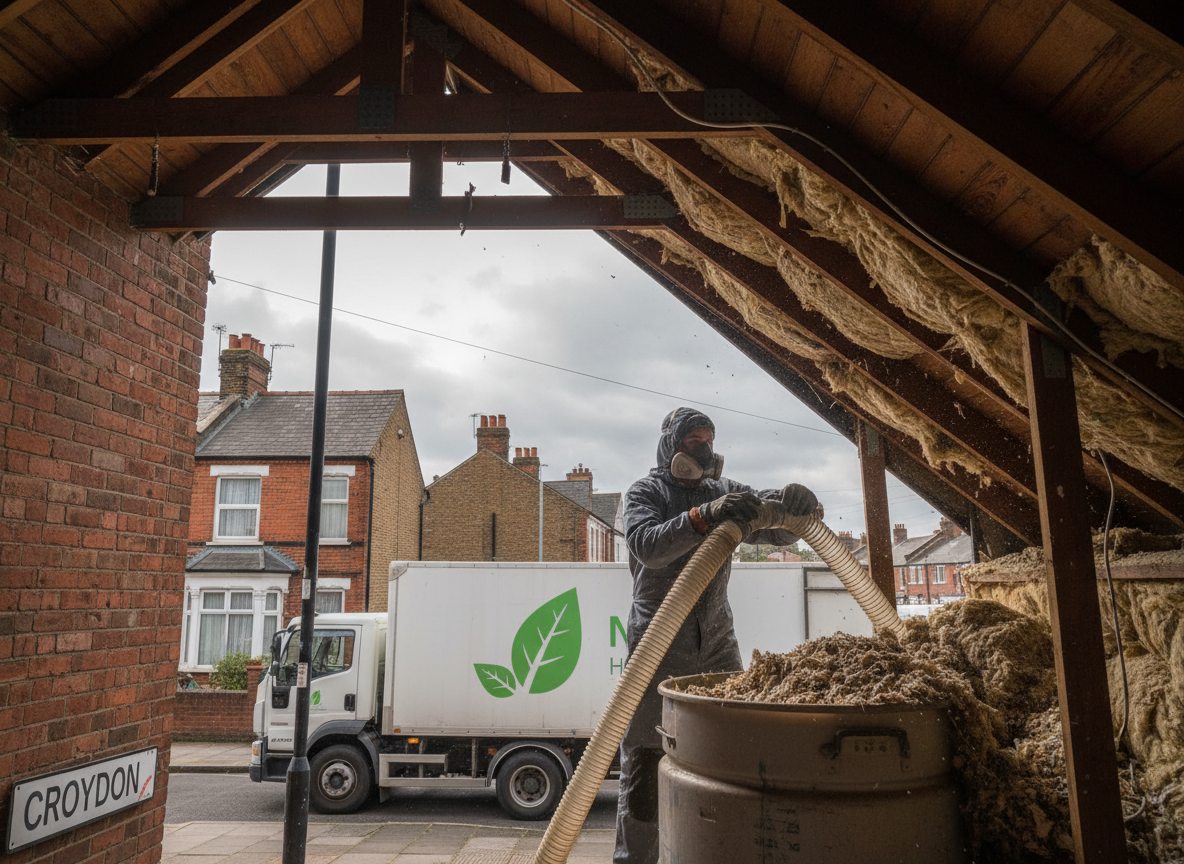
Croydon’s housing stock includes many 1930s semis and Edwardian terraces where closed-cell spray foam was applied directly to rafters in the 2000s. Over time the foam traps condensation against timber, especially during the area’s frequent wet winters when south-westerly winds drive rain under tiles. Removing it without solvents requires mechanical peeling followed by HEPA vacuuming so no residue enters the brickwork or neighbouring lofts. Homeowners in Addiscombe and Shirley often discover the foam has wicked into felt underlay, turning what looks like a simple scrape into careful layer-by-layer work to avoid tearing original roofing membranes.
Greater London planning rules on waste mean all removed foam must be separated from general construction debris before leaving site. In Croydon this usually means bagging the material at the Interchange depot for specialist recycling rather than landfill. Older properties around East Croydon station frequently have narrow access hatches and shared chimney breasts; technicians must build temporary dust screens across the entire loft to stop particles drifting into bedrooms below. The process also reveals whether the original roof has any slipped tiles or missing pointing that would otherwise go unnoticed until the next heavy downpour.
Because Croydon sits on London clay that swells and shrinks with seasonal moisture, any disturbance to loft ventilation can affect the whole building’s equilibrium. Environmentally friendly removal therefore includes reinstalling breathable insulation only after the rafters have dried for several days and new vents are fitted. This prevents the rapid reappearance of mould that residents in Thornton Heath and Norbury commonly report when foam is simply cut out and replaced without addressing airflow.
Technician insight
In Croydon, the thing that catches most people out with environmentally friendly insulation removal is how quickly 1930s brick semis hold moisture once the foam is gone; our damp winters and clay soil mean you must leave the rafters open for several days or mould returns within weeks.
Foam Removal in a 1935 Semi, Addiscombe
Homeowner noticed black mould on bedroom ceilings after heavy autumn rain. We found closed-cell foam had sealed in condensation against the rafters. After mechanical removal and three days of drying we added ridge vents; the mould has not returned and the loft now breathes with the rest of the terrace.
How it works
- 1
Initial Loft Survey
Assess foam depth, rafter condition and access points in Croydon properties.
- 2
Containment Setup
Install dust barriers and negative air units to protect living spaces below.
- 3
Mechanical Extraction
Peel foam in sections using low-solvent tools and bag material on site.
- 4
Rafter Drying and Ventilation Check
Allow timber to dry, then fit additional vents suited to local weather patterns.
- 5
Final Clearance
HEPA vacuum all surfaces and remove bagged waste for Croydon recycling streams.
Pricing
Cost depends on loft size, foam thickness and access difficulty; always provided as an upfront quote after inspection.