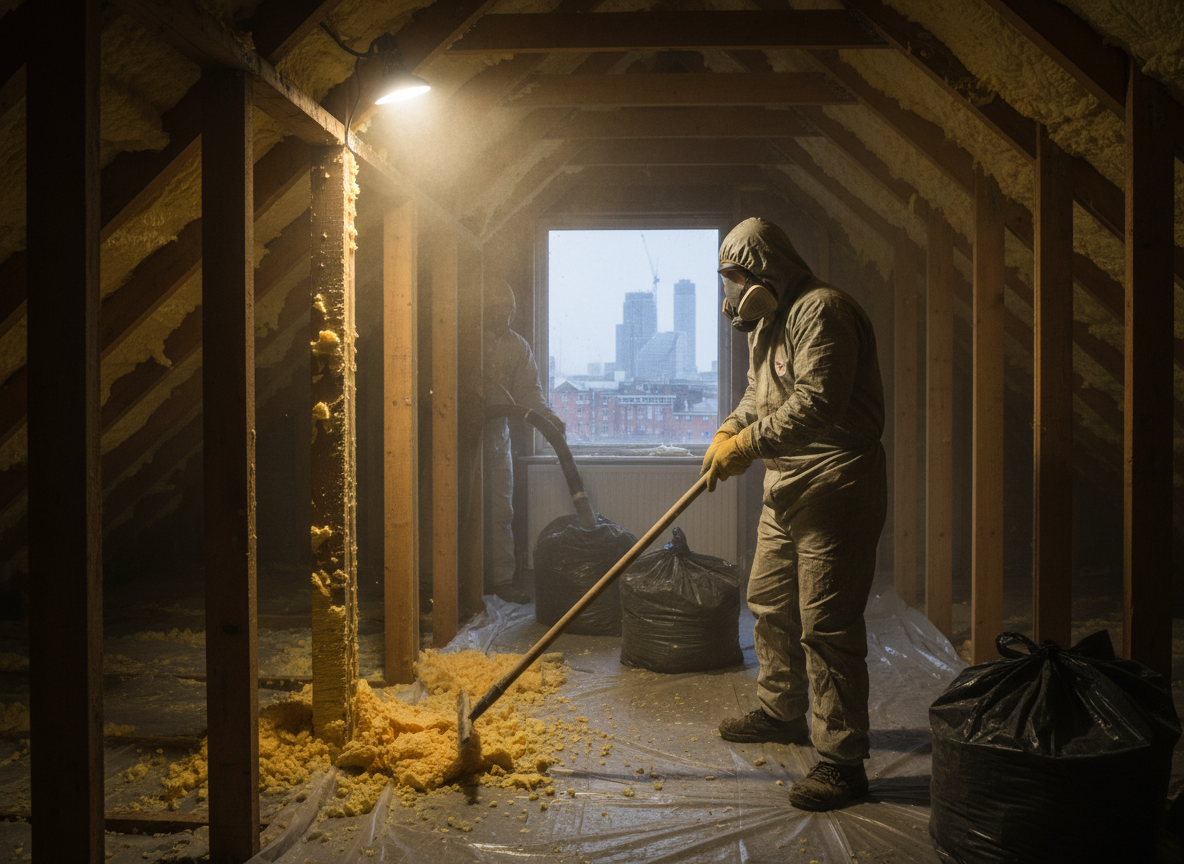
Closed cell spray foam bonds tightly to timber joists, brickwork and felt in Croydon roofs, often filling every gap in Victorian terraces and 1930s semis around Addiscombe and Shirley. Removing it requires cutting the foam into manageable sections without damaging original roof structures or disturbing hidden electrical runs common in these older builds. Moisture trapped beneath the foam can also affect rafters once the seal is broken, so careful ventilation checks are needed during extraction.
In the Croydon area, summer humidity and winter temperature swings make the foam expand and contract against substrates, sometimes leaving residue that must be mechanically scraped rather than simply peeled. Properties near the A23 corridor or on sloping sites around Purley often have limited loft access, requiring sectional dismantling and dust extraction to keep debris out of living spaces below. Homeowners frequently discover the foam was applied over existing insulation, adding extra layers that complicate the job.
Access and Substrate Challenges
Croydon housing stock from the early twentieth century frequently features narrow roof voids and mixed timber sizes that make full removal slower than in newer builds. Closed cell foam adheres aggressively to both felt and sarking boards, so crews must work methodically to avoid tearing underlayment that still sheds water during sudden downpours typical of the region.
Post-Removal Ventilation
Once foam is cleared, restoring airflow through eaves and ridge vents prevents condensation on exposed timbers. In Croydon properties this often means fitting new soffit vents or repairing damaged fascia boards before re-insulating with alternative materials that suit the original construction.
Technician insight
In Croydon, the thing that catches most people out with closed cell spray foam removal is the narrow roof voids in terraces between East Croydon and Thornton Heath where original rafters sit at awkward angles and foam was pumped right up against the eaves, leaving almost no working room once you start cutting.
Shirley Semi With Over-Applied Foam
Homeowner noticed damp staining on bedroom ceilings after heavy rain. Inspection revealed closed cell foam filling the entire eaves void and trapping moisture against the felt. We cut the foam back in sections, cleared residue from the rafters, restored eaves ventilation and left the roof ready for traditional insulation.
How it works
- 1
Site Assessment
Inspect loft and wall cavities to map foam depth, substrate condition and access points in the specific Croydon property.
- 2
Containment Setup
Protect floors and electrics, then establish dust extraction before cutting begins.
- 3
Sectional Removal
Cut foam into blocks and peel from joists and brickwork while monitoring for hidden services.
- 4
Residue Clearance
Scrape remaining material and vacuum all surfaces to leave a clean substrate.
- 5
Final Ventilation Check
Confirm restored airflow and advise on suitable replacement insulation options.
Pricing
Cost varies with property age, foam thickness and access difficulty; site visit required for accurate assessment.