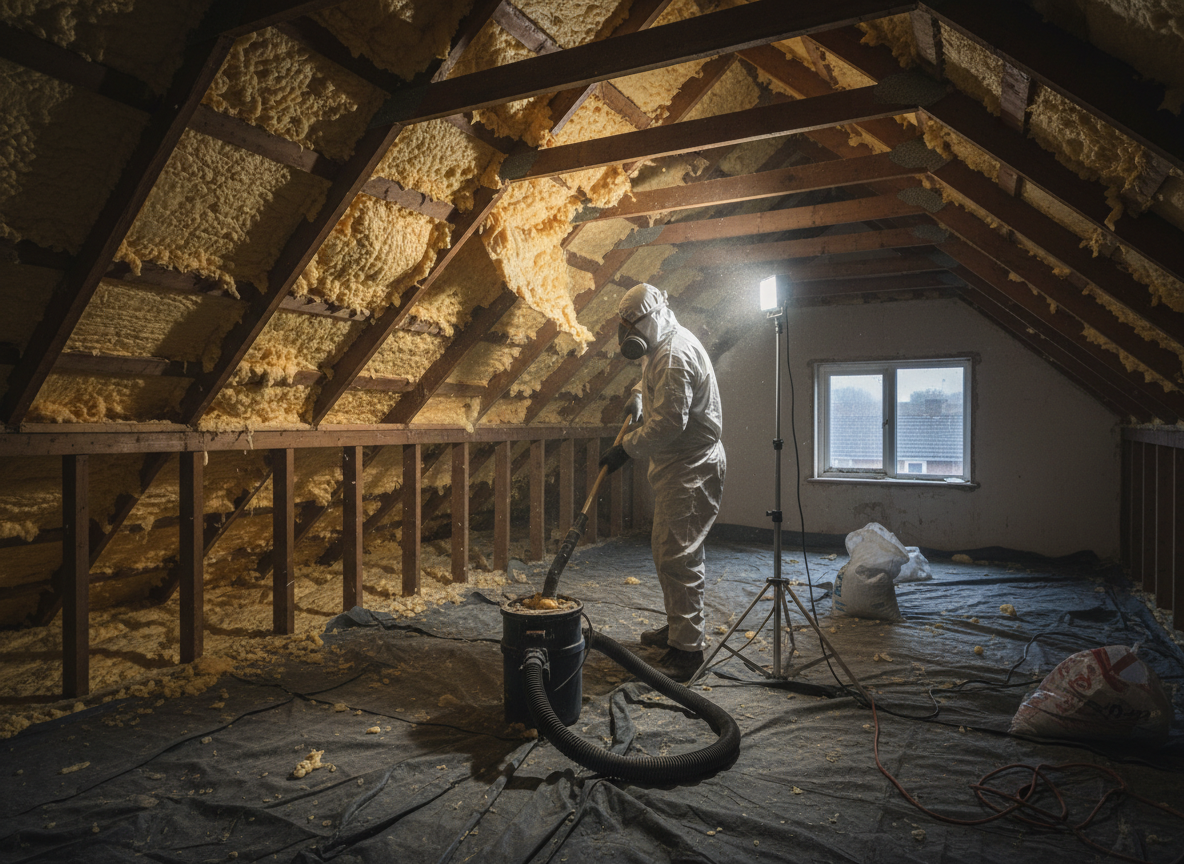
Attic spray foam removal in Croydon often involves older Victorian and Edwardian terraces common across South Croydon and Thornton Heath. These homes frequently have pitched roofs where closed-cell foam was applied directly to rafters, trapping moisture against original timber and leading to rot over time. Removal requires careful sectioning to avoid disturbing asbestos-containing materials sometimes present in mid-century ceilings, followed by ventilation upgrades to restore airflow that the foam had blocked. Weather in Greater London, with frequent damp winters, accelerates the problems when foam prevents natural drying, so crews must work in contained zones to prevent dust migration into living spaces below.
Homeowners in Croydon often discover issues during roof repairs or when selling, as surveyors flag the foam for blocking inspections and reducing breathability in lofts. The process starts with moisture readings and borescope checks through existing access points to map foam thickness and any hidden electrical or pipework. Extraction uses negative-air machines and HEPA filtration suited to the compact attic volumes typical in Croydon terraces, with debris bagged on-site for licensed disposal. Post-removal, rafters are cleaned and dried before any new insulation is considered, preventing repeat problems from residual foam particles that could affect adhesion.
Local conditions around Croydon, including clay-heavy soil and occasional heavy rainfall, mean attics can experience higher humidity levels that interact poorly with spray foam. Crews routinely find that foam applied in the 2000s has already begun to degrade at edges near eaves, requiring extra time to strip back to sound substrate. All work follows current building regulations on ventilation and fire safety, with temporary loft boarding installed where needed to protect stored items during the job. This approach keeps disruption minimal for residents in densely packed streets where access is limited to narrow side returns.
Technician insight
In Croydon, the thing that catches most people out with attic spray foam removal is how often the foam was sprayed right over the original eaves vents in 1930s semis around Addiscombe. Once winter temperatures drop and the house is heated, that blocked airflow pushes condensation straight into the ceiling joists, and homeowners only notice when the plaster starts staining.
Blocked Vents in a Thornton Heath Terrace
Homeowner called after a survey flagged the attic foam during a sale. Inspection showed closed-cell foam covering all original eaves vents in the 1930s terrace. We sectioned and removed the foam under containment, cleaned the rafters, and reopened the vents. The loft now breathes properly with no further moisture issues reported.
How it works
- 1
Initial Assessment
Inspect the attic for foam type, depth, and any moisture or structural concerns using borescope and moisture meters.
- 2
Containment Setup
Seal the work area with plastic sheeting and negative air machines to contain dust and protect the rest of the property.
- 3
Foam Extraction
Mechanically remove the spray foam in sections, bagging debris immediately for proper disposal.
- 4
Cleanup and Ventilation Check
Clean rafters and surfaces, then verify restored airflow meets requirements for the Croydon property.
Pricing
Upfront quotes after on-site inspection; price depends on attic size, foam thickness, and access constraints in Croydon terraces.